
Good taekwondo games for kids do two jobs at once: they teach a real skill and they make children want to come back next week. Below you will find six games, three with no equipment and three with a scoring protector set to an easy level. You will also see why instant feedback matters so much for young members and for the health of your club.
Why young members quit
Every club manager knows the pattern. A full children's class in September, a thinner one after the winter break. No statistic is needed to see the reasons on the mat:
- Too much waiting. Long lines for one kick on one pad.
- Too much repetition without a goal. Ten more, then ten more.
- Progress they cannot see. A grading every few months is a long time for a seven year old.
- Fear of contact. Sparring arrives too early or too hard.
- Comparison. The same strong children win everything.
Games answer most of these. They keep everyone moving, give a short clear goal and let each child succeed at their level.
Three games with no equipment
1. Traffic lights
Children move around the mat in fighting stance. You call a colour. Green: bounce and move. Amber: switch stance. Red: freeze in guard. Add a colour for a kick in the air. It trains listening, stance and reaction, and it works as a warm-up.
2. Belt tag
Each child tucks a spare belt or a band into the back of their belt, like a tail. In pairs or all together, they try to take the tail of others while protecting their own. No kicking. It teaches distance, footwork and awareness, which are the base of sparring, with no contact to fear.
3. Mirror
In pairs, face to face. One leads with steps forwards, backwards and to the side. The other copies and keeps the same distance. On your signal, the follower touches the leader's shoulder with a hand. Swap roles. It builds the habit of managing distance.
Three games with a scoring protector
For these games the protector is worn by an assistant, an older member or a partner of similar size. Set it to an easy level so that small children can score. FU FIGHT has an initiation version, adjustable to the level of the practitioner, designed for this purpose.
4. Beat your own score
Each child has a short time, for example twenty seconds, to score as many valid kicks as possible. Note the score. Later in the session, or the next week, they try to beat it. The opponent is their own number, so every child can win.
5. Team relay
Two teams, one protector each (two protectors in total). The first child runs up, scores one valid kick, runs back and tags the next. The team finishes when everyone has scored. Clean kicks beat rushed ones, and children work that out fast.
6. Target number
Give each pair a target, for example exactly six points using the real scale: 2 for a kick to the trunk, 4 for a turning kick. They must reach the number without going over. It teaches the scoring rules and control at the same time.
How instant feedback motivates
Children live in the present. "Good kick" from the coach is nice. A score that goes up when the kick lands is something else: it is immediate, it is fair and it does not depend on who the coach was watching.
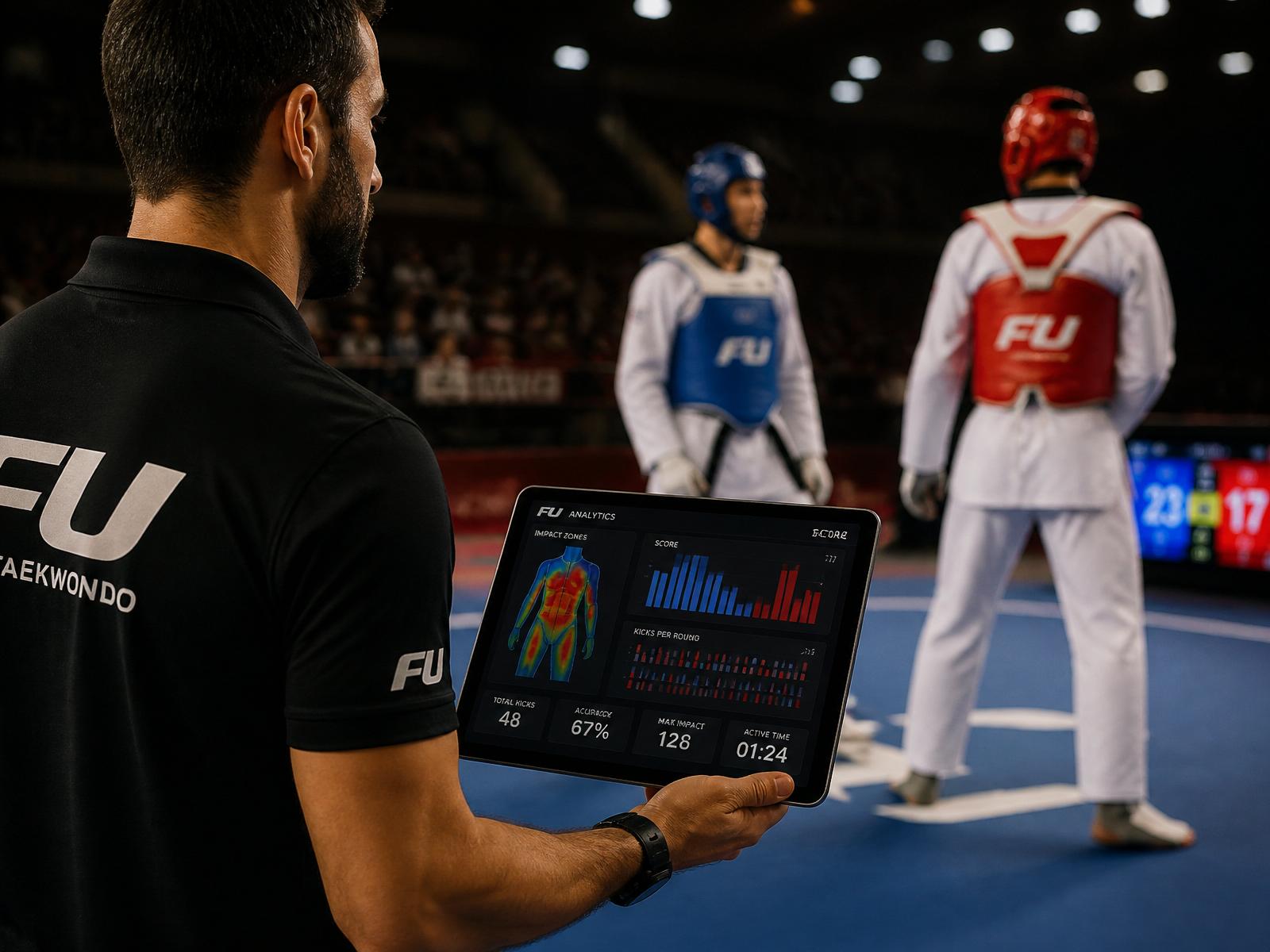
With a connected protector, the sensors detect valid hits and count the score automatically, and the result appears in real time in the app. For a child, that means:
- a clear link between what they did and what happened
- a goal they understand without a long explanation
- proof of progress between gradings
For shy children it also helps that the feedback comes from the equipment. Nobody is judging them. They just try again.
What it does for your club
A children's section that enjoys its classes is the base of most clubs. Parents see their child excited after training and they renew. Children talk about it at school. Open days are easier to run when you can let a newcomer kick a protector and see a score appear.
You also prepare future competitors gently: they learn clean contact and the point scale long before their first tournament.
Keep in mind that FU FIGHT is a training system. Official competitions use systems recognised by World Taekwondo.
FAQ
At what age can children use a scoring protector?
There is no single answer here. It depends on the sizes available and on your federation's rules for contact by age. Ask the supplier about sizes and start with games where an assistant wears the protector.
How long should a game last in a children's class?
Five to eight minutes is usually enough. Stop while they are still enjoying it, and they will ask for it next time.
Do games replace technique work?
No. They carry it. Choose each game for the skill it trains, and say that skill out loud before you start.
To see the initiation version in action, request the free documentation pack and the demo videos on the FU FIGHT site.
Ready to move to connected equipment?
Talk to our team about quotes, demos and partnerships.
Request a demo