
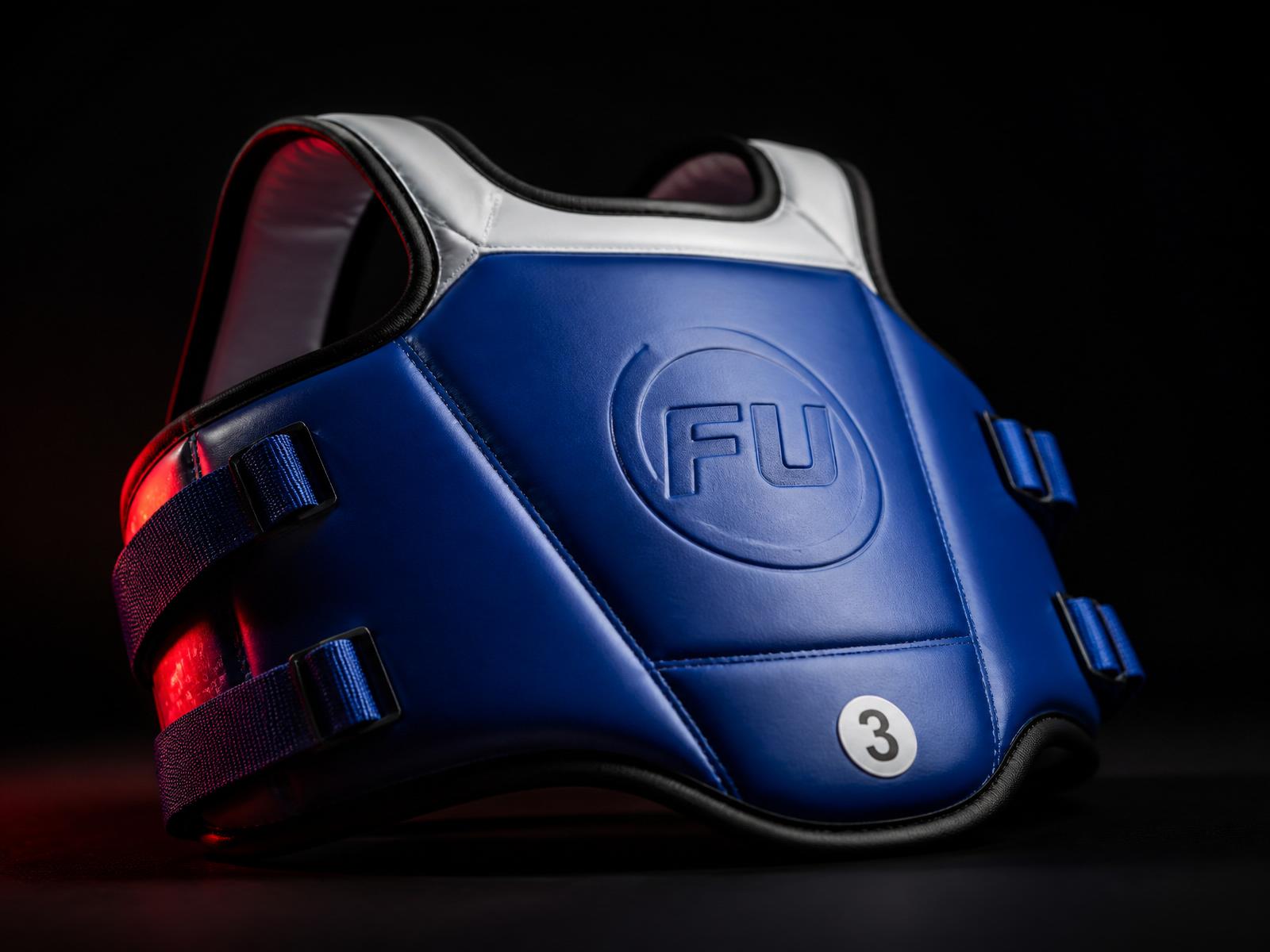
An electronic body protector in taekwondo is a hogu fitted with sensors that detect valid hits and count the score automatically. The score then goes to a screen or an app, so nobody has to judge each trunk kick by eye. This guide explains the principle, what counts as a valid hit, and the difference between a competition scoring system and a protector built for club training.
What is inside an electronic hogu
From the outside it looks like the protector your members already wear. The difference is under the cover.
- Sensors sit in the scoring area of the trunk. They react when a technique lands.
- Electronics read the sensor signal and decide whether the contact meets the conditions for a point.
- A wireless link sends the result to the device that shows the score.
In the competition systems used at official events, the fighters also wear sensor socks. The protector then knows that the contact came from a foot and not from a knee, a shin block or a push.
What counts as a valid hit
A valid hit is not just any touch. Three things matter.
- The target. The technique must land on the scoring area of the protector.
- The contact. It must be a clean strike with a permitted part of the body, not a scrape or a push.
- The force. The impact must reach a set level. In official competition that level depends on the weight and age category.
This is why fighters who are used to referees with clickers sometimes struggle. A kick that looks good and sounds loud may not register if it lands on the edge of the target or slides across it. The opposite also happens: a short, dull kick with clean contact scores.
How the score reaches the screen or the app
The path is the same in every system, with more or fewer steps.
| Step | What happens |
|---|---|
| 1. Impact | A technique lands on the protector |
| 2. Detection | The sensors and electronics check the hit |
| 3. Transmission | The result is sent wirelessly |
| 4. Display | The score appears for the people who need it |
In an official competition setup, the data goes to a receiver at the table and into scoring software. The software also takes input from the judges, who use handsets for punches and for the extra points given to turning techniques. The total is shown on the scoreboard.
In a training system such as FU FIGHT, the sensors in the protector detect valid hits and count the score automatically. The data is sent in real time to the coach and the athlete through a companion app.
Competition scoring systems and training protectors: two different jobs
It helps to separate the two families from the start.
Competition systems are the ones recognised by World Taekwondo for official events. Daedo and KPNP are the best known. They are designed to decide matches fairly, with a full chain of equipment: protectors, transmitters, a receiver and software. They need to be set up and run by people who know them.
Training protectors are designed for the club. Their job is not to referee an official match. Their job is to give the fighter and the coach feedback at every session. FU FIGHT belongs to this family. It is a training tool and is not presented as equipment for official competition.
The technology behind FU FIGHT comes from sport science research at Aix-Marseille University in France. The French Taekwondo Federation equipped itself with these connected protectors for the preparation of its athletes for the Paris 2024 Olympic Games.
What the coach gets out of it
Counting points is only the start. With FU FIGHT, the coach can analyse three things and adapt training to what they show:
- Precision: how the fighter's techniques land in relation to what counts.
- Intensity: how hard the fighter works and hits.
- The split between punches and kicks: what the fighter really uses in sparring.
Who it is for
- Competition squads that want to train under scoring conditions every week, not only on match day.
- Clubs with a mixed membership. FU FIGHT has an initiation version, adjustable to the level of the practitioner. It is designed to make learning more fun for beginners and children.
- Coaches of other striking sports. The technology is adaptable to other combat sports as a training tool. Karate is the example cited.
One practical point: you need at least two protectors to spar, one for each fighter.
FAQ
Is an electronic body protector heavier or harder to wear than a normal hogu?
It depends on the model, and we will not quote figures here. Ask the supplier for the documentation and try it on your fighters before you decide.
Can a training protector be used in an official competition?
No. Official competitions use systems recognised by World Taekwondo, such as Daedo or KPNP. FU FIGHT is a training system for clubs.
Does the protector score head kicks?
A body protector covers the trunk. In official competition, head kicks are handled by a separate electronic head guard or by the judges, depending on the event. Check the current rulebook for the details.
To see how it works in a real session, request the free documentation pack and the full demo videos on the FU FIGHT site.
Ready to move to connected equipment?
Talk to our team about quotes, demos and partnerships.
Request a demo