
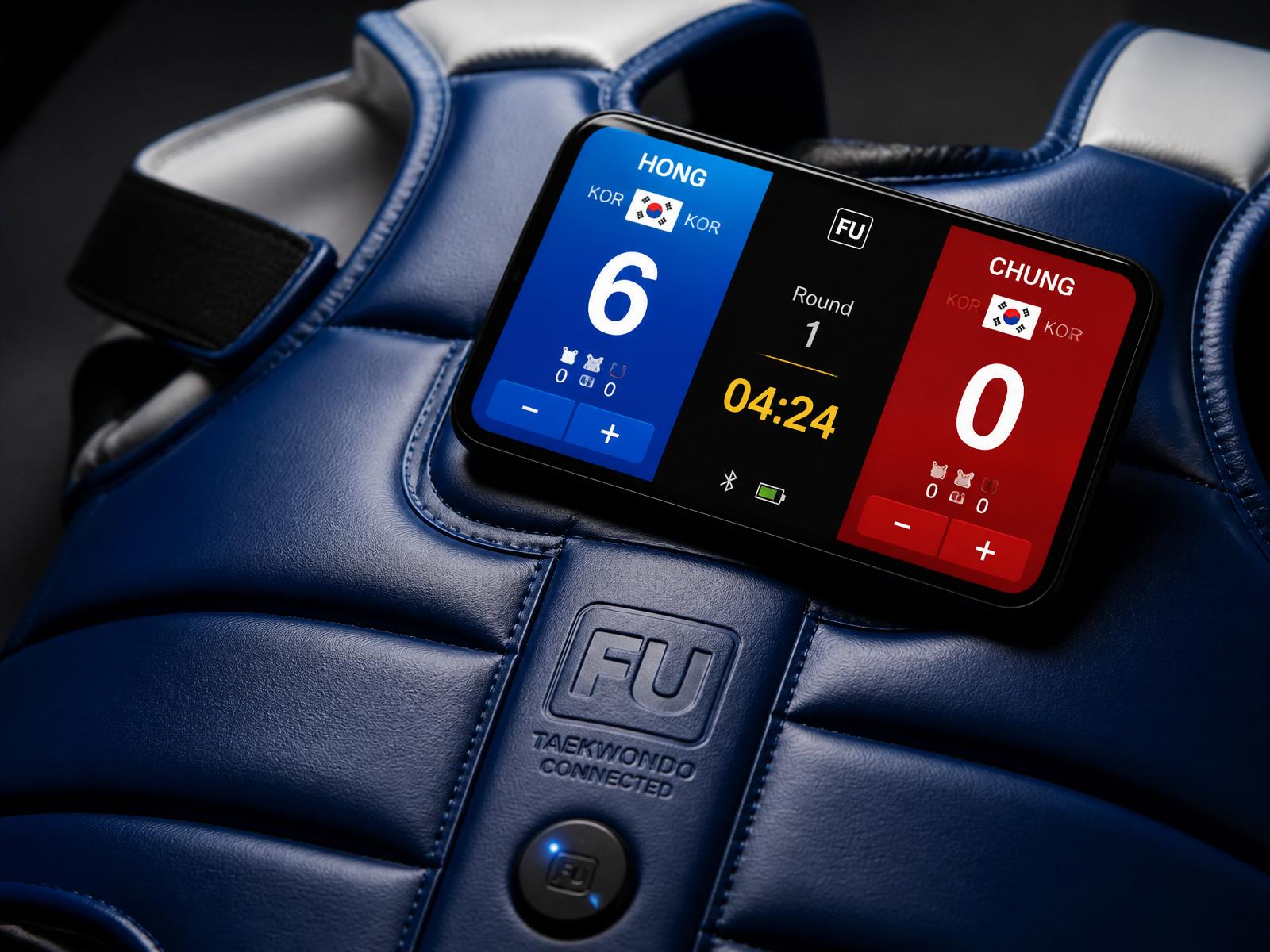
A connected chest protector for karate, sanda or kickboxing is a training tool, and how well it fits depends on your sport. Where the trunk is a scored target and a protector is already worn, the fit is direct. Where scoring depends on control and form, or where nobody wears a body protector in a bout, it helps with drills but cannot stand in for a referee. Here is an honest view, sport by sport.
Where the technology comes from
FU FIGHT is a connected chest protector designed for taekwondo training in clubs. Sensors in the protector detect valid hits and count the score automatically. The data goes in real time to the coach and the athlete through a companion app, and the coach can analyse precision, intensity and the split between punches and kicks.
The technology comes from sport science research at Aix-Marseille University in France. It is adaptable to other combat sports as a training tool, and karate is the example cited. What follows is our reading of how that could apply, discipline by discipline. For your own sport, ask for the documentation and say what you practise.
Sanda and sports where a trunk protector is worn
In sanda, fighters wear a chest protector in many competition formats, and techniques to the trunk score. Coaches already work with the idea of a protected, scored target.
This is the most direct fit. In training, a protector that counts valid hits on the trunk can help with:
- kick and punch accuracy on the body
- volume and intensity over rounds
- comparing a fighter's sessions over several weeks
Keep one limit in mind. Sanda also scores throws, sweeps and techniques to other targets. A chest protector sees none of that. It measures one part of the game.
Karate kumite
Karate needs more care. In kumite, a point is not given for impact alone. Judges look at form, control, timing, distance, attitude and awareness after the technique. A technique that hits too hard can be penalised. No sensor can assess all that, so a connected protector cannot referee a karate bout, and it should not be presented that way.
At training it has a place, as a measuring tool:
- Precision. Did the technique reach the target area on the trunk, or fall short?
- Volume. How many body techniques does the athlete really deliver in a round?
- Hands versus feet. The split between punches and kicks tells a lot about a kumite fighter's habits.
- Consistency. Does accuracy hold when the athlete is tired?
Some karate styles and many clubs already use body protectors in training, especially for juniors. In those settings the tool fits into what you already do. One open question to raise with the supplier: how the detection level can be set for a sport where contact must stay controlled.
Kickboxing, muay thai and boxing
In these sports nobody wears a body protector in a bout, and scoring is done by judges who weigh clean, effective strikes over the whole round. A connected protector has no role in refereeing here.
It can still be useful as a partner drill tool:
- the partner wears the protector as a moving target for body kicks, teeps or body shots
- the fighter works a set time and looks at how many clean hits landed
- the coach tracks body work over a training block
It complements body shields and pad work. It is not a replacement for them. The partner in a protector moves, reacts and counters, which pads do less well. And many fighters in these sports neglect the body, so a body work counter can be a good incentive.
Be realistic about the limits: no head shots, no low kicks, no clinch work, no elbows or knees are assessed. And a protector designed for taekwondo kicks may not respond in the same way to every strike from another sport. Test before you commit.
Summary by sport
| Sport | Is the trunk a scored target with a protector worn? | Use of a connected protector |
|---|---|---|
| Taekwondo | Yes | Training with automatic score counting |
| Sanda | Yes, in many formats | Direct fit for trunk techniques at training |
| Karate kumite | Trunk scores, but on control and form | Measuring precision and volume at training |
| Kickboxing, muay thai, boxing | No protector in a bout | Partner drills for body work |
In every case this is a training tool. It is not presented as recognised by any federation for official competition, in taekwondo or elsewhere.
FAQ
Is FU FIGHT available in a karate version today?
The technology is described as adaptable to other combat sports, with karate as the cited example. For what is available now for your discipline, ask the supplier directly.
Can it score a kumite or kickboxing bout?
No. Scoring in those sports depends on criteria that referees and judges assess. Use it to measure and motivate at training.
How many protectors would a club need?
At least two for sparring. For partner drills where only the target wears one, you can start to test the idea with fewer. The price is 350 EUR per protector.
If you coach another striking sport, request the free documentation pack and the demo videos on the FU FIGHT site, and say which discipline you practise.
Ready to move to connected equipment?
Talk to our team about quotes, demos and partnerships.
Request a demo